

Hiring Flat But Recovering: November 2025 Gusto Small Business Jobs Report

The Gusto Small Business Jobs Report provides a real-time view of hiring among the 400,000+ U.S. small businesses on Gusto. All figures are based on anonymized payroll data and are statistically weighted to be nationally representative by size, industry, region, and company age. We track America’s small business economy of companies with less than 50 employees. |
Gusto Small Business Jobs Report
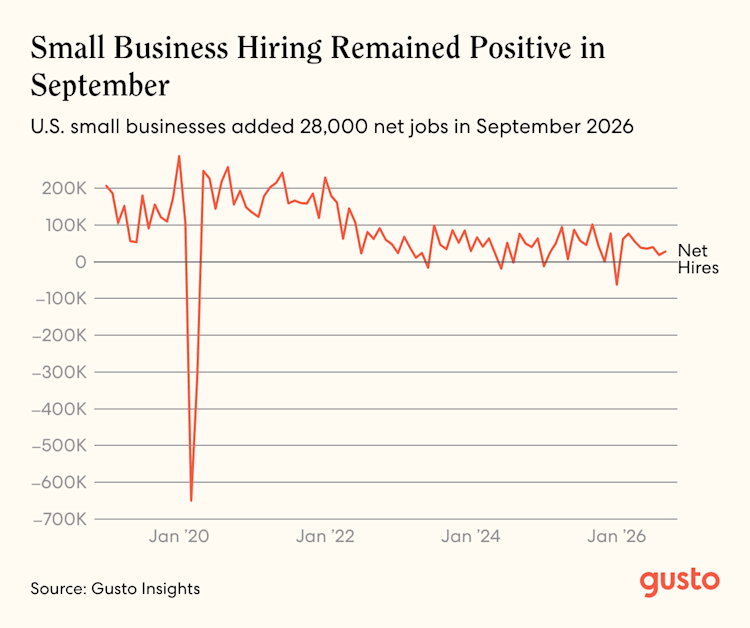
Hiring among America’s small businesses was essentially flat in November, posting a modest -2,000 net job loss for the month — a sharp rebound from October’s revised decline of -37,900 jobs, but well below the 12-month average of 43,500 jobs added by U.S. small-businesses with less than 50 employees.
However, below the surface there are pockets of strong hiring among small businesses in November, including health care, construction, and wholesale trade. By contrast, most job losses were led by small businesses in retail, hospitality, and professional services.
While hiring in November remained muted, it shows a broader trend of stabilization in small business hiring rather than a steep dropoff. With the Federal Reserve now actively moving to cut interest rates – easing small-business borrowing costs that have weighed on hiring for over two years – we expect U.S. hiring to gradually improve in the months ahead.
The Big Picture: Hiring Slow But Rebounding from October
Gusto data show that in November there were an estimated -2,000 net hires among small businesses nationally on a seasonally adjusted basis. While this represents only a modest net decline, it marks the second consecutive month of negative net hiring – a signal that many small businesses remain cautious amid ongoing economic uncertainty.
Here’s how November 2025 small-business net hiring compares to recent months:
August 2025: +45,900 net hires
September 2025: +101,400 net hires
October 2025: -37,900 net hires
November 2025: -2,000 net hires
U.S. small businesses hired 2.284 million workers in November, while terminations (employee separations for any reason) reached 2.286 million, resulting in a slight net loss of jobs nationally. The 12-month average now stands at +40,000 net hires per month (December 2024 – November 2025).
Notably, the overall pace of both hiring and terminations has slowed from a year ago – a trend dubbed the “Great Freeze” by some economists. Hiring for small businesses peaked at 3.4 million per month in January 2022, and has since fallen by 33% to current levels. Hirings by small businesses were down -5% from one year ago in November, and separations were down -3.3%.
Most economists believe this slowdown is due to a combination of persistent high interest rates, as well as uncertainty around tariffs and AI’s impact on work, leading business owners to be cautious about expanding their teams.
A note on revisions: Each month we revise our initial estimates from the past two months to reflect payroll changes by small business owners recorded since our last report. This month, our September net hires figure was revised upward from our initial estimate of +19,100 to +101,400 net hires – suggesting that late-summer hiring was stronger than initially reported. Meanwhile, October was revised downward from -5,900 to -37,900 net hires, reflecting a deeper pullback than initially observed.
Health Care and Construction Drive Growth, Hospitality and Retail Struggle
The November small business hiring picture varied dramatically by industry. On the positive side, several sectors continued adding workers to payrolls:
Health Care and Social Assistance: +9,500 net hires
Construction: +7,000 net hires
Wholesale Trade: +4,500 net hires
Finance and Insurance: +1,400 net hires
Other Services (repair shops, salons, personal care): +1,200 net hires
Healthcare continues to be a star performer among America’s small businesses – not just in November, but across the past year. Over the last 12 months, healthcare small businesses have added an average of 14,900 jobs monthly, far outpacing every other sector. Construction has also been resilient, averaging 6,400 net hires monthly over the past year.
But several other sectors saw net job losses in November:
Accommodation and Food Services: -6,500 net hires
Retail Trade: -5,500 net hires
Professional, Scientific, and Technical Services: -4,200 net hires
Manufacturing: -2,500 net hires
Administrative and Support Services: -2,500 net hires
The weakness in hospitality and retail likely reflects ongoing consumer caution and uncertainty heading into the holiday season. The pullback in professional services – which had been adding an average of 3,000 jobs per month over the past year — suggests that white-collar small businesses are facing headwinds as well.
What It Says About Holiday Hiring
November’s data offers a sobering view of this year’s holiday hiring season among small businesses.
Retail trade small businesses posted -5,500 net hires in November – their weakest November performance in at least four years, and well below the three-year average of roughly flat hiring (on a seasonally adjusted basis) during this critical pre-holiday month. Gross hiring in Retail reached 279,000 workers in November, down from last November’s 283,000, suggesting retailers are approaching the season with unusual caution.
By contrast, Wholesale Trade small businesses showed surprising strength with +4,500 net hires – the best November in four years and triple the three-year average. This divergence hints at a disconnect in the holiday supply chain: Wholesalers are adding workers to move inventory (partly for online sales) but brick-and-mortar-oriented retailers are holding back on hiring, possibly anticipating softer consumer demand.
Even after we account for seasonal hiring patterns, these trends suggest U.S. small businesses expect a more muted holiday shopping season than in recent years.
Regions: South and West Show Resilience, Northeast Struggles
November’s regional numbers show a shift from recent patterns. The South showed the strongest small business growth in November with +1,700 net hires, followed by the West at +1,400. These southern and western regions appear to be stabilizing after October’s weakness.
Meanwhile, the Northeast saw notable job losses with -4,500 net hires, while the Midwest posted -600 net jobs. This represents a reversal from October, when the Northeast and Midwest performed best.
Over the past 12 months, the South has been the clear leader, averaging +15,800 net hires monthly, followed by the Midwest at +9,000 and the West at +8,200. The Northeast has been the weakest region at +7,000 monthly on average.
Company Size: Smallest Businesses Stabilize, Largest Pull Back
Breaking down the data by company size reveals an interesting pattern in November:
1-4 employees: +2,600 net hires
5-9 employees: +5,500 net hires
10-19 employees: +30 net hires
20-49 employees: -10,200 net hires
The smallest businesses (1-4 employees) bounced back from October’s losses, while businesses with 5-9 employees continued their strong performance. However, the largest small businesses (20-49 employees) bore the brunt of November’s weakness, posting substantial job losses.
Over the past 12 months, businesses with 5-9 employees have been the strongest performers, averaging +12,200 net hires monthly, closely followed by businesses with 10-19 employees at +11,100 and those with 20-49 at +10,700. The smallest businesses (1-4 employees) have averaged +6,000 monthly.
Takeaways for Small Businesses
November’s flat small-business job growth – following October’s steep decline – suggest that small business hiring is recovering from its recent soft patch this fall, although it remains still well below its 12-month average.
However, the overall U.S. hiring number masks an important reality: Many bright spots of strong hiring remain among America’s small-business economy. Health care continues its strong run of job creation, and construction and finance are both adding jobs at a healthy clip as of November. And the nation’s smallest businesses appear to be stabilizing. However, weakness in consumer-facing sectors like hospitality and retail, combined with pullbacks in professional services and among larger small businesses, point to ongoing economic uncertainty.
Looking ahead, we expect small business hiring to progressively improve in coming months, as the impact of recent Fed interest rate cuts begins to reduce the cost of small business borrowing, and as the overall U.S. economy feels the lift of easing monetary policy.
Methodology
The Gusto Small Business Jobs Report tracks anonymized payroll data from a stratified random sample of roughly 100,000 small businesses across the United States with 1-49 employees, drawn from the 400,000+ companies on Gusto. All figures in this report are seasonally adjusted unless otherwise noted.
To ensure the findings represent small businesses across the United States, Gusto uses a two-stage weighting process. First, we randomly select a representative sample of companies (roughly 100,000 businesses annually) that match the national distribution of small businesses by industry, company size, and geographic region, using U.S. Bureau of Labor Statistics “Quarterly Census of Employment and Wages” data as a benchmark. Second, we adjust the sample to reflect the national distribution of company ages based on data from the Census Bureau’s “Business Dynamics Statistics”.
This report provides three key metrics for small businesses each month: Hires (new employees starting work), terminations (employees leaving for any reason), and net hires (the difference between hires and terminations, showing whether small businesses are creating or losing jobs overall). All data are seasonally adjusted using the U.S. Census Bureau’s X-13ARIMA-SEATS methodology to account for predictable fluctuations throughout the year, making it easier to identify meaningful trends in small business employment. All data are freely available for download at http://gusto.com/insights.

Keep Reading
Small Businesses Add 28,000 Jobs as Pay Rises 4.0%: September 2026 Gusto Small Business Jobs and Pay Report

Small Businesses Using AI Grow Headcount 7% Faster Than Peers

Small Businesses Add 29,500 Jobs as Pay Rises 3.9%: August 2026 Gusto Small Business Jobs and Pay Report
