

As Inflation Surges, Teen Wages Are Keeping Pace

The job market for teen workers has been resilient, even as hiring has slowed elsewhere in the economy. Small businesses — particularly in education, recreation, food service, and hospitality — are still turning to young workers to meet seasonal demand, and wages for teen workers are now growing faster than wages for older adults. This report explores the latest trends in teen hiring, wages, and employment growth across the country.
Key Findings
Teen Hiring Remains Resilient: Nearly one-in-five (18.6%) new hires in May 2026 was a teen between the ages of 15 and 19, consistent with levels seen in previous years (18.4% in May 2025 and 17.7% in May 2024).
Teen Wages Are Rising Faster Than Inflation: Teen pay is increasing faster than inflation, even as inflation has accelerated in recent months amid rising energy prices. As of May 2026, the average wage for teens at small businesses was $15.29/hour—a 4.0% increase from the year before, outpacing the 3.8% rise in consumer prices.
Southern and Midwestern Metros Had the Highest Teen Share of Total Hires: Teens accounted for a larger share of total hires in Southern and Midwestern metro areas, with New Orleans and St. Louis teens accounting for upward of 30% of May 2026 hires.
Teen Hiring Remains Resilient Despite Overall Slowdown
The share of teen hires typically rises sharply in late spring and early summer, reflecting the influx of seasonal and part-time jobs available to teenagers during school breaks. Workers between the ages of 15 and 19 have made up about 20% of all June hires over the past three years compared to about 10% of all hires during the fall and spring months when teens tend to be in school.
Overall hiring rates have trended downward for all age groups in recent years, but the slowdown has been similar across age groups. Summer 2026 is on track to be consistent with historical range for teens’ share of new summer hires. As of May 2026, 18.6% of all new hires were between the ages of 15 and 19, compared to 18.4% in May 2025 and nearly a percentage point above the 17.7% of all hires in May 2024.
Teen Wages Are Rising Faster Than Inflation
After slowing from 2022 through 2025, wage growth for teen new hires has been re-accelerating over the past year. For much of 2025, wage growth was essentially the same for teen workers and for prime age (25-54 years old) workers. But a gap has reemerged in 2026 with new teen hires receiving an average of $15.29/hour, 4.0% more than new teen hires in May 2025.
Even as consumer price inflation has accelerated in recent months amid rapidly rising energy prices, touching 3.8% in April 2026 according to the Consumer Price Index, newly hired teen workers are seeing real pay gains after adjusting for inflation. The same is not currently true for prime age workers for whom pay is currently increasing by about 1.9% on an annual basis.
The relative strength of pay gains for newly hired teens reflects continued hiring challenges in sectors of the economy that tend to employ seasonal workers – notably recreation, food service, and leisure and hospitality. Even as the job market for professional workers – who tend to be older, since they require higher levels of education – has slowed, the job market remains tight in many of the service sectors that rely on teen workers.
Hottest Cities and Subsectors for Teenage Workers
Metro Areas
Teen hiring is particularly strong in cities with thriving tourism and service sectors. According to Gusto data, metros in the South and Midwest are seeing the highest concentration of teen hires this summer—reflecting their strong demand for seasonal workers in recreation and hospitality. This aligns with national data from the Bureau of Labor Statistics (BLS), which shows that leisure and hospitality accounted for upward of 25% of teen employment in 2025.
Industries
Education is the leading industry for teen employment in 2026, displacing Entertainment & Recreation, which led last year. Food service and hospitality round out the top industries for teen employment similar to past year. Employers are increasingly reliant on teens to meet seasonal demand, especially as older workers shift away from part-time roles and growth in the immigrant workforce slows. This dynamic keeps demand—and wages—strong for younger workers in frontline service jobs.
(The annual declines in average wages for newly hired teens in the Education, Tourism & Accommodation, and Government sectors is driven by a shift in hiring toward lower cost metros than within-metro wage declines.)
Conclusion
The 2026 data confirm that the teen labor market is running on a different track than the rest of the economy. While hiring overall has cooled, small businesses in education, recreation, food service, and hospitality continue to lean on teen workers to fill seasonal gaps, keeping teens' share of new hires at 18.6% in May — in line with, or slightly above, the past two years. That steady demand is now showing up in paychecks: teen wages rose 4.0% year-over-year, outpacing both consumer price inflation (3.8%) and wage growth for prime-age workers (1.9%), a reversal from 2025 when the two groups were growing at similar rates.
This pattern points to a labor market where the sectors most dependent on young, seasonal workers remain tight even as hiring for older, more credentialed roles slows. Geographically, that tightness is most visible in Southern and Midwestern metros like New Orleans and St. Louis, where teens make up nearly a third of new hires, and industry-wide, in education's rise to the top spot for teen employment, ahead of entertainment and recreation.
As small businesses continue to compete for a limited pool of seasonal labor, teen wages are likely to remain a leading indicator of tightness in the broader service economy — one worth watching as summer hiring peaks and inflation trends continue to evolve.

Keep Reading
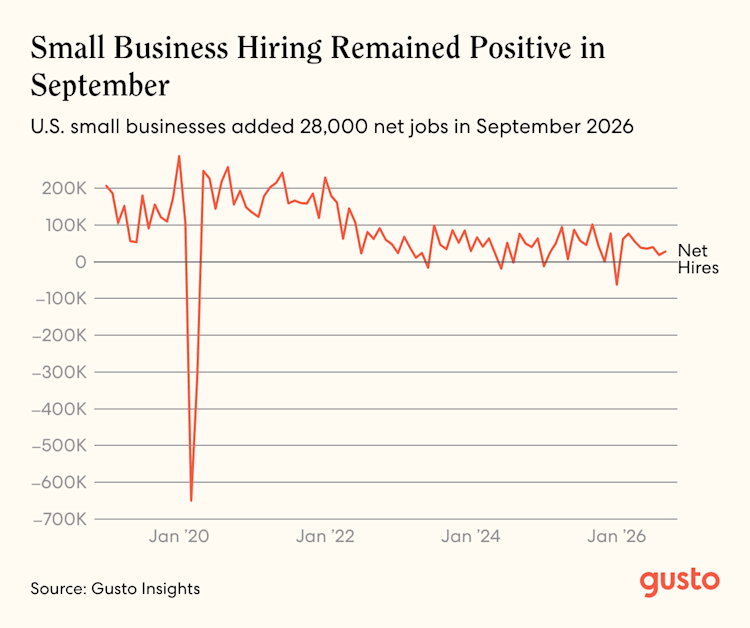
Small Businesses Add 28,000 Jobs as Pay Rises 4.0%: September 2026 Gusto Small Business Jobs and Pay Report

Small Businesses Using AI Grow Headcount 7% Faster Than Peers

Small Businesses Add 29,500 Jobs as Pay Rises 3.9%: August 2026 Gusto Small Business Jobs and Pay Report
