

What “No Tax on Tips and Overtime” Means for Small Business Workers in 2026

At a Glance
Starting in 2026, workers earning tips or overtime may see slightly bigger paychecks under new federal tax deductions created by the One Big Beautiful Bill Act (OBBBA).
Small-business workers who earn tips will see an average tax savings of about $392 per year, or $19 per paycheck. However, the median is much lower: $100 per year or $6.21 per paycheck.
Workers who earn overtime will see an average tax savings of about $118 per year or $5.23 per paycheck. The median worker will see savings of only $20 per year, or about $1 per paycheck.
Workers with tips will benefit more than those with overtime pay, because the full tip amount qualifies for the deduction, while only the “premium” portion of overtime does – the 0.5 portion of the standard “time and a half” overtime rate.
Over 99% of the roughly 1 million workers we examined qualify for some tax savings, with almost none phased out due to high income.
Total tax savings for small business employees across our sample add up to an estimated $269 million annually for both tax deductions.
What’s Changing in 2026?
The One Big Beautiful Bill Act (OBBBA), signed into law in 2025, creates new federal income tax deductions for workers who earn tips or overtime pay. These provisions apply for tax years 2025 through 2028, offering a temporary boost to take-home pay for millions of American workers.
Here’s what small business owners and workers need to know:
Tips deduction: Workers in customary tipped occupations can deduct up to $25,000 in tips from their taxable income.
Overtime deduction: Workers can deduct up to $12,500 (single tax filers) or $25,000 (joint tax filers) of qualified overtime pay.
Income limits: The deductions phase out for workers earning above $150,000 (single tax filers) or $300,000 (joint filers).
There’s an important detail in the new law that many workers may not realize: for overtime pay, only the “premium” portion qualifies for the deduction, not the full time-and-a-half amount. When you earn overtime at 1.5x your regular rate, the premium is just the extra 0.5x, which works out to about one-third of your total overtime pay. This significantly reduces the tax benefit compared to tips, where the full amount qualifies.
How Much Will Workers Actually Save?
To estimate the real-world impact of these deductions, we analyzed payroll data for a sample of over 1 million employees on Gusto who earned tips or overtime in 2025. Our analysis simulates the tax savings workers could see starting in 2026, based on their actual earnings, filing status, and estimated marginal tax rates.
The results show a wide range of outcomes. For workers with tips, the median tax savings – meaning half of workers save more and half save less – will be about $100 in annual tax savings, or roughly $6.21 per paycheck. But because the distribution is highly skewed, some workers will see substantially more.
Estimated per-paycheck tax savings for small-business employees earning tips
For workers with overtime pay, the median tax savings will be about $20 in annual tax savings, or roughly $1 per paycheck. As with the tips deduction, the distribution of savings is highly skewed across the small-business workforce.
Estimated per-paycheck tax savings for small-business employees earning overtime
These wide spreads of tax benefits reflect the reality that many workers have modest tip or overtime income, while a smaller group – often full-time tipped workers or those with significant overtime hours – will see more meaningful increases in take-home pay. Overall, the savings will be meaningful for some workers, but small for most.
Tips vs. Overtime: Not All Savings Are Equal
One of the most striking findings from our analysis is the disparity between tip-based and overtime-based savings. Workers who earn tips see average annual savings of $392, compared to just $118 for overtime workers – a difference of more than 3x.
Why this gap? It comes down to what qualifies for the deduction. For tips, the full amount counts. For overtime, only the premium portion – roughly one-third of total overtime pay – qualifies. A worker earning $6,000 in overtime can only deduct about $2,000, while a worker earning $6,000 in tips can deduct the full amount.
Annual estimated tax savings by type of earnings
Workers fortunate enough to earn both tips and overtime see the largest benefits, with mean annual savings of $848. However, this group represents less than 10% of all workers in our sample.
Who Benefits Most?
The tax savings vary considerably by income level, though not always in the direction you might expect. Middle-income workers ($50,000-$100,000) tend to see the largest dollar savings, driven by a combination of higher tip and overtime earnings and higher marginal tax rates compared to lower earners.
The table below shows the combined estimated tax savings in our sample of small-business employees from both the tips and overtime deductions.
Tax savings from new tips and overtime deductions will vary widely by income group
Notably, the vast majority of small business workers we examined would fall well under the tax deduction caps. Among those earning tips, over 97% earn less than the $25,000 maximum, and for overtime, over 99% fall below their applicable limit. This means the caps will rarely bind for most small business workers.
Perhaps more importantly, very few workers are excluded from the deduction due to high income. Only about 1,900 workers in our sample – less than 0.2% – are phased out entirely. That means although the tax savings are small for most, this will be a tax change that broadly benefits workers.
Some Hypothetical Examples
To make the above estimates of possible tax savings more concrete, here are four hypothetical examples of what savings workers can expect based on typical scenarios we observe among small-business employees.
Full-time restaurant server ($8,000 in annual tips): With $8,000 in tip income and a 12% marginal tax rate, this worker could save about $960 per year – roughly $37 per paycheck for someone paid biweekly.
Construction worker ($6,000 in annual overtime): Only about $2,000 of the $6,000 qualifies as the “premium” portion. At a 22% marginal tax rate, annual savings come to around $440, or about $17 per paycheck.
Part-time bartender ($2,000 in annual tips): At a 10% marginal tax rate, this worker would save about $200 per year – roughly $8 per paycheck.
Warehouse worker ($1,500 in annual overtime): With only $500 qualifying as the premium portion and a 12% marginal rate, annual savings would be around $60, or about $2 per paycheck.
What This Means for Small Business Owners
For small business owners, the main takeaway from these 2026 tax changes is operational: to get the full benefit of the new law, employees will need to submit an updated Form W-4 to take advantage of these new tax deductions. Workers who don’t update their W-4 may have to wait until filing their tax return next year to claim the deduction.
During this transition period, employers are also likely to receive questions from workers about how the deductions work, particularly around the overtime premium calculation. Having a basic understanding of these new tax provisions can help set expectations with employees appropriately.
Methodology
This analysis is based on anonymized payroll data from a sample of over 1 million employees on Gusto who earned tips or overtime compensation in calendar year 2025. We estimated tax savings by applying the OBBBA deduction rules to each worker’s actual tip and overtime earnings, using their estimated annual income as a proxy for Modified Adjusted Gross Income (MAGI) and their filing status to determine applicable marginal tax rates and phaseout thresholds.
Key assumptions include: (1) only one-third of total overtime pay qualifies as the “premium” portion under the 1.5x overtime rule; (2) all workers earning tips are in qualifying tipped occupations as defined by the U.S. Department of Treasury; and (3) eligible workers submit an updated 2026 Form W-4 to benefit from adjusted withholding. Actual tax savings will depend on individual circumstances and final IRS guidance.
Note: This analysis is provided for informational purposes only and does not constitute tax advice. Workers and small-business owners should consult a qualified tax professional for guidance on their specific situation.

Keep Reading

Nearly 10% of small businesses that grow add employees across state lines
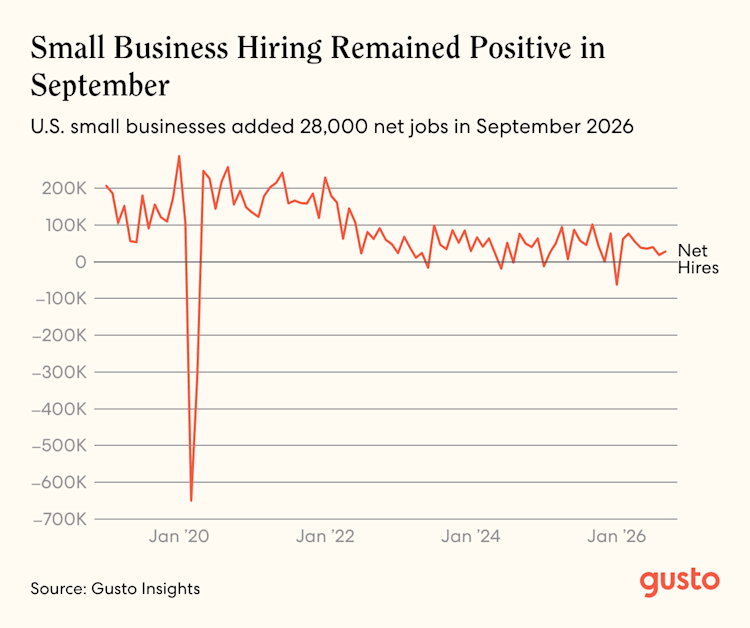
Small Businesses Add 28,000 Jobs as Pay Rises 4.0%: September 2026 Gusto Small Business Jobs and Pay Report

Small Businesses Continue to Offer Health Insurance to Employees, Despite a 7% Annual Rise in Premiums
