

Small Businesses Add 105,700 Jobs: February 2026 Gusto Small Business Jobs Report

Hiring among America’s small businesses posted a strong rebound in February, adding +105,700 net new jobs for the month, well above the 12-month average of 55,100 jobs. The February gain marks a substantial year-over-year improvement from February 2025’s +25,900 net hires, reinforcing that small business hiring is on firmer footing heading into 2026.
Below the surface, February’s picture was notably broad-based. Healthcare posted solid gains (+24,800 jobs), as did consumer-facing sectors like accommodation and food services and retail trade. Importantly, professional services rebounded sharply this month (+6,300 jobs) after posting significant losses in January. Equally notable: all four U.S. regions and all company size tiers posted net job gains in February – a meaningful shift from January’s more uneven performance.
The overall picture suggests small business hiring entered 2026 on a strong footing. With February’s broad-based gains, the trajectory for America’s small businesses appears cautiously positive. That said, the very smallest businesses continue to lag larger small businesses in net hiring over the trailing year, a fault line worth watching in the months ahead.
The Big Picture: February Hiring Surges
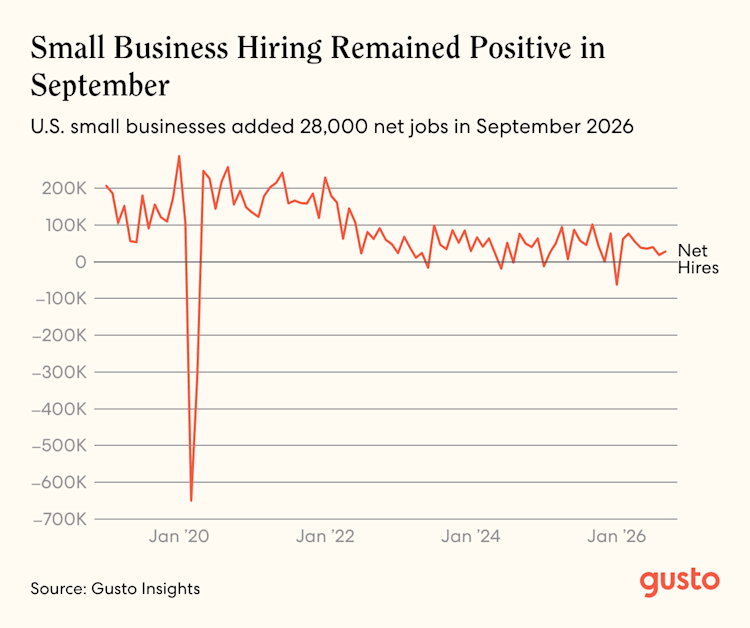
Gusto data show that in February there were an estimated +105,700 net hires among small businesses nationally on a seasonally adjusted basis. This represents a strong rebound from January’s revised estimate of a 8,200 net job loss, and is well above the pace from last February of +25,900 net hires, revealing a notable acceleration in America’s small business job growth.
Here’s how February 2026 small-business net hiring compares to recent months:
October 2025: +43,900 net hires
November 2025: +500 net hires
December 2025: +77,100 net hires
January 2026: –8,200 net hires
U.S. small businesses hired 2.02 million workers in February, while terminations (employee separations for any reason) reached 1.88 million, resulting in solid net job growth nationally. The 12-month average now stands at +55,100 net hires per month for the nation overall (March 2025 – February 2026).
Notably, the overall pace of both hiring and terminations remains below the pace we saw a year ago, a trend we’ve repeatedly referred to as the “Great Freeze” in the labor market. Hirings by small businesses were down -16.9% from one year ago in February, and separations were down -20.9%.
Most economists believe this slowdown in the overall pace of hiring and terminations reflects persistent caution among business owners and workers, as uncertainty around tariffs and AI’s impact on work continues to weigh on Americans’ minds.
A note on revisions: Each month we revise our initial estimate from past months to reflect payroll changes by small business owners recorded since our last report. This month, our January net hires figure was revised downward from our initial estimate of +37,100 to –8,200 net hires, a significant downward revision. We believe this largely reflects the impact of bad weather across the country during the final week of January, which slowed hiring and drove a higher-than-usual volume of late terminations, neither of which were fully captured in our initial estimate. Because we run our model 5–7 days before the end of each month, the initial estimates may be sensitive to major economic events (such as major winter storms) that occur during the last week of the month. Some hires that employers had planned for January may have shifted into February instead, which may partly explain February's strong reading. February's gains provide some reassurance, but the softness in January is worth monitoring in coming months.
Broad Sector Gains Led by Healthcare and Hospitality
The February small business hiring picture was remarkably broad-based across sectors. Healthcare and consumer-facing industries posted strong gains, and professional services bounced back sharply:
Health Care and Social Assistance: +24,800 net hires
Accommodation and Food Services: +17,700 net hires
Other Services: +13,200 net hires
Retail Trade: +9,400 net hires
Transportation & Warehousing: +8,600 net hires
Professional, Scientific, and Technical Services: +6,300 net hires
Administrative and Support Services: +5,900 net hires
Construction: +5,800 net hires
As in previous months, healthcare remains the standout performer among America’s small businesses. The rebound in professional services – from a revised 9,100 net job loss in January to +6,300 in February – is particularly notable, suggesting that the white-collar pullback seen last month may have been temporary rather than the start of a sustained trend.
Only a small number of sectors posted job losses in February:
Information: –1,200 net hires
Agriculture: –300 net hires
Management of Companies: –200 net hires
The breadth of February’s gains – with 16 out of 19 sectors posting positive net hires – is one of the strongest cross-sector readings in recent months, and a meaningful contrast to January’s more uneven picture.
Regions: All Four Post Gains, South Leads
February’s regional numbers showed a notable shift from January – all four U.S. regions posted positive net hires, with the South leading the way:
South: +43,500 net hires
Midwest: +22,700 net hires
West: +21,200 net hires
Northeast: +18,300 net hires
The breadth of February’s regional gains is a notable development. In January (revised), the South and Northeast were the regions posting net job losses, while the Midwest and West remained positive. February’s recovery – with all four regions now contributing to net job growth – suggests hiring strength was broad-based geographically, and not concentrated in any single part of the country.
Company Size: Broad Recovery Across All Tiers
Breaking down the numbers by company size reveals another encouraging development in February – all four size tiers posted positive net hires:
20–49 employees: +58,200 net hires
10–19 employees: +25,900 net hires
5–9 employees: +14,800 net hires
1–4 employees: +6,700 net hires
This broad recovery across all size tiers is a meaningful reversal from January’s pattern, when the smallest businesses (1–4 employees) experienced significant job losses while larger small businesses continued growing. The return of the smallest tier to positive territory in February is encouraging, though it is worth noting that the 12-month trailing average for this group remains just +900 net hires per month, far below the pace of larger small businesses.
Over the past 12 months, businesses with 20–49 employees have averaged +23,300 net hires monthly, followed by those with 10–19 employees at +16,100 and 5–9 employees at +14,900. The smallest companies averaged just +900 per month, underscoring that while February brought welcome relief for the smallest business, the longer-term gap between the smallest and largest small businesses remains a concern.
Takeaways for Small Businesses
February's strong and broad-based hiring numbers with +105,700 net hires, and with all four regions and all company sizes posting gain, represent one of the most encouraging monthly readings in recent months. The year-over-year improvement of nearly +80,000 net hires compared to February 2025's +25,900 is a clear signal that America's small business economy is on solid footing heading into 2026. That said, the data reveal important nuances. The "Great Freeze" in overall hiring and termination volumes persists, with both measures still running well below year-ago levels.
Looking ahead, February's broad job gains are a strong positive signal. The job gains in the professional services sectors, and across four regions point to a small business economy that is growing with breadth and momentum as 2026 gets underway.
Methodology
The Gusto Small Business Jobs Report tracks anonymized payroll data from a stratified random sample of roughly 100,000 small businesses across the United States with 1–49 employees, drawn from the 400,000+ companies on Gusto. All figures in this report are seasonally adjusted unless otherwise noted.
To ensure the findings represent small businesses across the United States, Gusto uses a two-stage weighting process. First, we randomly select a representative sample of companies (roughly 100,000 businesses annually) that match the national distribution of small businesses by industry, company size, and geographic region, using U.S. Bureau of Labor Statistics “Quarterly Census of Employment and Wages” data as a benchmark. Second, we adjust the sample to reflect the national distribution of company ages based on data from the Census Bureau’s “Business Dynamics Statistics.”
This report provides three key metrics for small businesses each month: Hires (new employees starting work), terminations (employees leaving for any reason), and net hires (the difference between hires and terminations, showing whether small businesses are creating or losing jobs overall). All data are seasonally adjusted using the U.S. Census Bureau’s X-13ARIMA-SEATS methodology.

Keep Reading
Small Businesses Add 28,000 Jobs as Pay Rises 4.0%: September 2026 Gusto Small Business Jobs and Pay Report

Small Businesses Using AI Grow Headcount 7% Faster Than Peers

Small Businesses Add 29,500 Jobs as Pay Rises 3.9%: August 2026 Gusto Small Business Jobs and Pay Report
