
Small Businesses Add 29,500 Jobs as Pay Rises 3.9%: August 2026 Gusto Small Business Jobs and Pay Report

Key Takeaways
August extended the streak of small business job gains to seven straight months, but at +29,500 it was the most modest gain of the year’s streak, slipping below the 12-month average as summer’s momentum eased.
Breadth narrowed but held: 13 of 19 sectors, all four regions, and every company size tier still added jobs, even as six of nineteen sectors — led by hospitality — posted net losses.
Health care remains the clear engine of small business hiring, and with gains still spread across every region and company size, the labor market looks to be downshifting rather than stalling as it heads into the fall.
Pay kept climbing even as hiring cooled. Average hourly earnings were up 3.9% year over year and starting pay for new hires up 3.2% — so August’s slowdown looks like fewer new positions, not softer wages.
The Gusto Small Business Jobs and Pay Report provides a real-time view of hiring and pay among U.S. small businesses on Gusto. All figures are based on anonymized payroll data and are statistically weighted to be nationally representative by size, industry, region, and company age. We track America’s small business economy of companies with fewer than 50 employees.
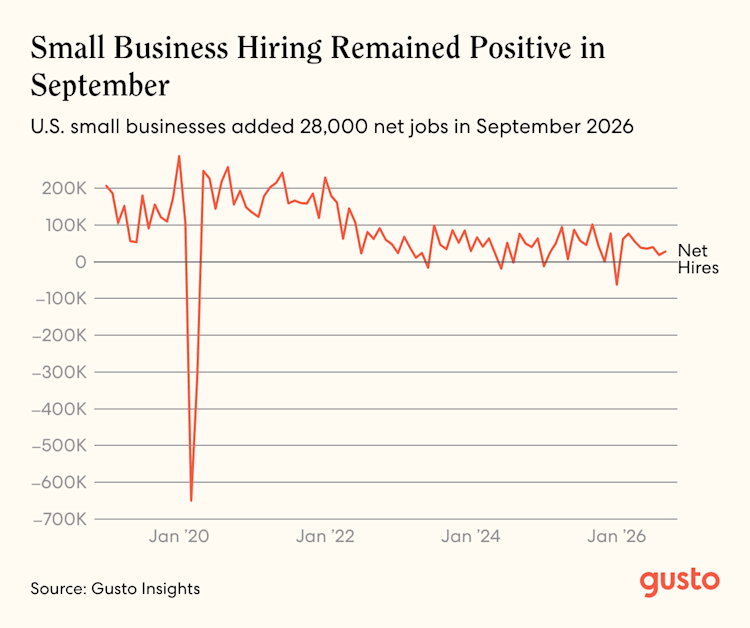
August was a softer, but still positive, month for small business job growth, with America’s small businesses adding an estimated +29,500 net new jobs on a seasonally adjusted basis. August’s gain marks the seventh consecutive month of positive net hiring following January’s dip, but the pace cooled to the most modest gain of that streak, slipping below the 12-month average as summer momentum eased.
Even as the headline cooled, hiring stayed broadly positive. Health care and social assistance again led all sectors with +16,300 net hires, followed by construction (+4,200) and administrative and support services (+2,100). 13 of 19 sectors posted positive net hires — narrower than July’s 16, as mining, utilities, and transportation and warehousing slipped from positive into negative territory (hospitality and agriculture were already shedding jobs). Additionally All four U.S. regions added jobs, led by the South at +14,200, and every company size tier stayed in positive territory.
Pay, meanwhile, kept climbing. Average Hourly Earnings, the average wage across small business workers reached $37.31 an hour in August, up 3.9% from one year earlier, and starting pay for newly hired workers was up 3.2%. Small businesses are still giving raises and increasing pay for new workers even as they add workers more cautiously heading into the fall.
The Big Picture
At +29,500, August’s seasonally adjusted net hires came in below the 12-month average of +41,700. Here’s how the month compares to the recent trend:
April 2026: +54,900 net hires
May 2026: +38,200 net hires
June 2026: +35,800 net hires
July 2026: +42,400 net hires
Prior months were revised with this release. Compared with last month’s report, June was revised down to +35,800 (from +40,800), and July was revised up to +42,400 (from +38,200). As always, the most recent months are subject to revision as additional payroll data arrives.
On pay, Average Hourly Earnings reached $37.31 in August, up 3.9% from a year earlier. Year-over-year small business wage growth has hovered around 4% for much of 2026 — ranging from about 3.9% to 4.6% — with August at the lower end of that band.
New hires are seeing raises too: the New Hire Pay Index was up 3.2% year over year, to about $25.78 an hour. Explore the live pay charts on Gusto’s Real-Time Economic Data page.
Sector Breakdown
Health Care and Social Assistance led all sectors for the month with +16,300 net hires, extending its run atop the rankings, though the pace eased from July’s +17,500. Construction ranked second at +4,200, with Administrative and Support Services (+2,100) and Other Services (+1,900) rounding out the leaders.
Regional Breakdown
All four U.S. regions posted positive net hires in August:
South: +14,200 net hires
West: +6,600 net hires
Midwest: +4,500 net hires
Northeast: +4,200 net hires
The South held its position atop all regions again in August at +14,200 net hires, though off the +16,900 pace it set in July. The West came in second at +6,600, followed by the Midwest at +4,500 and the Northeast at +4,200. Gains stayed positive everywhere but eased from July in three of the four regions — only the West edged up — as the regional picture broadly cooled in step with the national headline.
Pay tells a similar regional story. Wage growth is strongest in the West, where small business pay rose about 5.1% over the past year, the fastest of any region. The South also saw solid pay gains of about 4.0%, ahead of the Northeast (about 3.6%) and the Midwest (about 3.1%), where wage growth has been the most muted.
Company Size Breakdown
All four company size tiers posted positive net hires in August:
5–9 employees: +9,400 net hires
10–19 employees: +9,200 net hires
20–49 employees: +8,000 net hires
1–4 employees: +2,900 net hires
Gains were spread relatively evenly across company sizes in August. The 5–9 employee tier led at +9,400, with the 10–19 tier close behind at +9,200 and firms in the 20–49 employee range adding +8,000. The smallest 1–4 employee businesses contributed +2,900. All tiers stayed positive, but each pulled back from earlier in the summer — a uniform cooling rather than weakness concentrated in any one segment.
Methodology
The Gusto Small Business Jobs and Pay Report tracks anonymized payroll data from a stratified random sample of roughly 100,000 small businesses across the United States with 1–49 employees, drawn from the 400,000+ companies on Gusto. All figures in this report are seasonally adjusted unless otherwise noted.
To ensure the findings represent small businesses across the United States, Gusto uses a two-stage weighting process. First, we randomly select a representative sample of companies (roughly 100,000 businesses annually) that match the national distribution of small businesses by industry, company size, and geographic region, using U.S. Bureau of Labor Statistics “Quarterly Census of Employment and Wages” data as a benchmark. Second, we adjust the sample to reflect the national distribution of company ages based on data from the Census Bureau’s “Business Dynamics Statistics.”
This report provides three key hiring metrics for small businesses each month: Hires (new employees starting work), terminations (employees leaving for any reason), and net hires (the difference between hires and terminations, showing whether small businesses are creating or losing jobs overall). All data are seasonally adjusted using the U.S. Census Bureau’s X-13ARIMA-SEATS methodology.
We also track two small business pay measures: Average Hourly Earnings and the New Hire Pay Index (the typical starting wage for newly hired workers). Both are seasonally adjusted.

Keep Reading
Small Businesses Add 28,000 Jobs as Pay Rises 4.0%: September 2026 Gusto Small Business Jobs and Pay Report

Small Businesses Using AI Grow Headcount 7% Faster Than Peers

Small Businesses Add 38,200 Jobs: July 2026 Gusto Small Business Jobs Report